
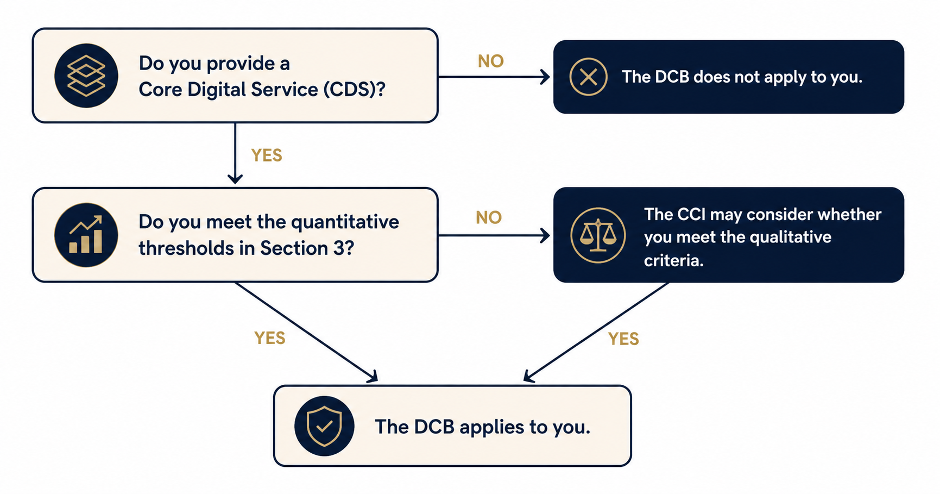
Which Providers are Designated as SSDEs?
An enterprise is eligible for designation if it provides any of the 9 Core Digital Services (CDS) listed in Schedule I and holds a “significant presence” in India for that specific service (Section 3(1)).
The targeted CDS categories are (Schedule I, Paragraph 1):
-
Online search engines
-
Online social networking services
-
Video-sharing platform services
-
Interpersonal communications services
-
Operating systems
-
Web browsers
-
Cloud services
-
Advertising services
-
Online intermediation services
The Two-Track Designation Criteria
Track A: Quantitative Thresholds (Deemed Status)
An enterprise is automatically deemed an SSDE if it simultaneously crosses at least one financial metric AND one user metric in each of the 3 immediately preceding financial years (Section 3(2)):
Financial Thresholds (Meet any ONE)
-
India Turnover: INR 4,000 crore; OR
-
Global Turnover: USD 30 billion; OR
-
Gross Merchandise Value (GMV) in India: INR 16,000 crore; OR
-
Global Market Capitalisation/Fair Value: USD 75 billion
-
Note: If the enterprise is part of a corporate group, all the financial and user metrics listed above must be calculated across the entire group globally (Section 3 (Explanation 7)).
User Thresholds (Meet any ONE in India)
-
End Users: 1 crore (10 million) in India; OR
-
Business Users: 10,000 in India.
-
Note: Unlike the EU’s Digital Markets Act (DMA), which requires meeting both end-user and business-user thresholds cumulatively, the DCB triggers designation if either user threshold is met. This could potentially capture enterprise-only services with high business user counts but zero end users.
Track B: Qualitative Factors
Even if an enterprise misses the numbers above, the Competition Commission of India (CCI) can qualitatively designate it if it believes the firm has a “significant presence” based on (Section 3(3)):
-
Economic power, size, resources, and total volume of commerce.
-
User dependence, switching costs, and behavioral biases causing user lock-in.
-
ANetwork effects, data-driven advantages, and integration across multiple sides of the market.
-
Barriers to entry, structural/service characteristics, and market scale.
The Step-by-Step Designation Procedure
The statute establishes a precise process for how an enterprise officially transitions into a regulated SSDE:
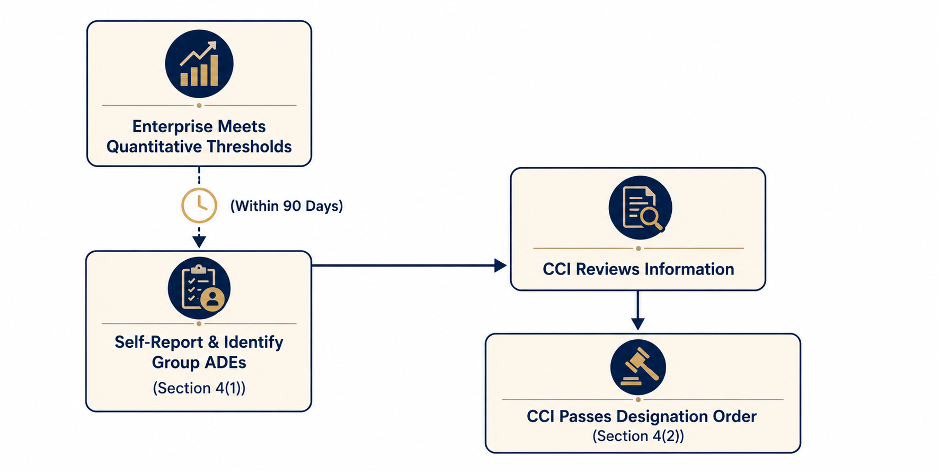
Step 1: Mandatory Self-Reporting
-
Any enterprise that meets the quantitative thresholds must proactively notify the CCI within 90 days in the specified form (Section 4(1)).
-
In the same notification, the firm must identify other enterprises within its corporate group that are directly or indirectly involved in providing that core digital service in India; these are designated as Associate Digital Enterprises (ADEs) (Section 4(1), 4(9)).
-
ANetwork effects, data-driven advantages, and integration across multiple sides of the market.
-
Barriers to entry, structural/service characteristics, and market scale.
Step 2: The CCI Evaluation & Show-Cause Process
The designation order can be triggered in three ways depending on the track:
-
For Self-Reporters: Upon receiving a clean, valid self-report, the CCI simply passes an order designating the enterprise as an SSDE, identifying its specific regulated Core Digital Services, and applying Chapter III behavioral rules (Section 4(2)).
-
For Non-Reporters (Quantitative Track): The CCI can independently direct any enterprise to furnish data to verify its threshold status (Section 4(3)). If the data reveals the company met the criteria but failed to report it, the CCI will hold a hearing, pass a designation order, and issue a show-cause notice asking why a failure-to-notify penalty should not be levied (Section 4(4)).
-
For the Qualitative Track: If the CCI targets an enterprise using qualitative factors, it must issue an initial show-cause notice explaining its reasoning (Section 4(5)). After evaluating the response and granting an official hearing, the CCI will either finalize the SSDE designation order or close the case entirely (Section 4(6)).
Note:
If an enterprise refuses to cooperate, gives incomplete info, or fails to comply with data directives, the CCI can penalize the firm and issue a default designation order using whatever available information is in its possession (Section 4(7)).
Step 3: Fixed Tenure & Re-Designation
-
A formal designation as an SSDE or an ADE is legally valid for a fixed period of 3 years (Section 4(8), 4(9)).
-
On the exact date of expiry, the enterprise is automatically deemed re-designated for another 3 years unless an active revocation order has been passed by the CCI (Section 6(5)).
Anti-Circumvention Controls
-
Enterprises are prohibited from contractually, commercially, or technically segmenting, dividing, subdividing, fragmenting, or splitting their services just to artificially stay under the user or financial thresholds (Section 5(1)).
-
If the CCI catches an enterprise splitting services to avoid detection, it holds the power to directly step in and designate the entity as an SSDE (Section 5(3)). This happens without prejudice to separate structural penalties under the Act (Section 5(3)).
Assessment of the DCB’s designation criteria and procedure
A. Designation Criteria
What works
-
Simplicity and Clarity: Applying uniform criteria across the board provides structural simplicity and clear rules for enforcement.
-
Alignment with Global Standards: Using objective quantitative parameters to define systemic significance aligns the domestic framework with established international regulatory precedents.
-
Capturing Diverse Vectors of Scale: Incorporating multi-dimensional metrics (India turnover, global turnover, gross merchandise value, and global market capitalization) alongside raw user counts evaluates platform significance from multiple financial angles.
What doesn’t
-
Risk of Over-Inclusion: The proposed quantitative benchmarks are too low, creating a risk of inadvertently capturing fast-growing domestic firms and startups that do not pose systemic competitive risks.
-
Overtly broad definition of ‘ADEs’: By binding the designation to any enterprise within a corporate group that is "directly or indirectly involved in the provision of the Core Digital Service," the definition lacks a clear nexus to actual market power or systemic competitive significance. The ambiguity of "indirect involvement" grants sweeping discretion to capture minor intra-group vendors, peripheral backend infrastructure providers, or localized subsidiaries that carry no independent risk of anti-competitive behavior.
-
Flaws of a Uniform Approach: Applying identical thresholds across diverse Core Digital Services (CDSs) overlooks distinct sector structures, risking excessive regulation in some markets (e.g., cloud computing) and insufficient regulation in others.
-
Ambiguity in Calculation Metrics: Enterprises face steep practical difficulties in applying and calculating specific metrics like global turnover, gross merchandise value (GMV), and localized user counts without precise calibration or clear guidance.
-
Absence of a Rebuttal Mechanism: Unlike the EU's Digital Markets Act, the current criteria strictly bind an enterprise to designation once thresholds are crossed, lacking a mechanism to rebut the presumption in exceptional cases.
B. Designation Process
What works
-
Proactive Market Protection: Shifting from reactive ex-post enforcement to an ex-ante designation process addresses the rapid concentration of digital power before anti-competitive conduct inflicts irreversible harm.
-
Ecosystem-Wide Anti-Circumvention: The workflow includes specific safeguards that prevent platforms from artificially splitting, segmenting, or fragmenting their digital services to remain under statutory thresholds.
-
Structured Timelines: Imposing a definitive 90-day self-reporting timeline on threshold-crossing enterprises ensures a structured and predictable entry into the regulatory regime.
What doesn’t
-
Severe Institutional Capacity Constraints: The complexity of digital markets places an immense strain on the CCI, which is severely short-staffed and lacks the specialized talent (data scientists, technologists) to handle ex-ante workflows.
-
Lack of an Evidence-Based Foundation: The current process risks a hasty implementation driven by broad definitions rather than being guided by finalized context-specific assessments and robust sector market studies.
-
Regulatory Overlap and Conflict: The process exposes firms to parallel proceedings and contradictory compliance rules between the DCB and existing laws, such as the Competition Act and the DPDP Act.
-
Administrative and Litigation Roadblocks: The enforcement framework faces significant procedural headwinds, including an insufficiency of independent regulatory funds and a high pendency of litigation challenging orders..