
26 July 2019:
The Report of the Competition Law Review Committee (CLRC) highlighted the need to build an active competitive environment in which businesses could thrive and innovate keeping pace with new age developments in digital markets, particularly through atypical business models synonymous with new age markets. The CLRC specifically evaluated how digital platforms, data ownership, and network effects transformed market power and competitive dynamics. However, it recommended updating the existing statutory framework to evaluate algorithmic collusion, online vertical restraints, and introducing a deal-value threshold to ensure the regulatory framework effectively captured asset-light, high-value digital transactions.
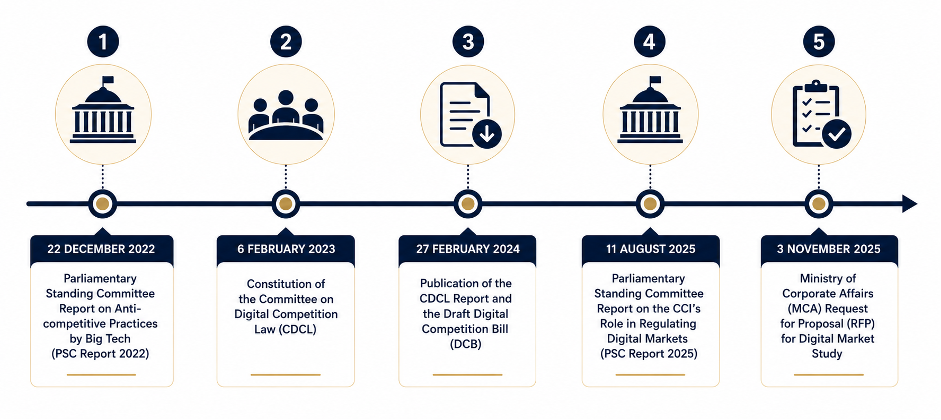
22 December 2022:
In December 2022, the Parliamentary Standing Committee on Finance published a watershed report titled “Anti-Competitive Practices by Big Tech Companies,” which fundamentally shifted India’s approach to regulating the digital economy. The report highlighted the following aspects:
-
The Unique Nature of Digital Markets: The Committee emphasized that digital markets are structurally distinct from traditional markets, characterized by rapid "tipping" effects, strong network externalities, and data aggregation capabilities. These dynamics allow a few dominant platforms to entrench themselves as powerful "gatekeepers" very early in the market lifecycle.
-
Insufficiency of the Existing Framework: The report explicitly noted that the existing ex-post (after-the-fact) enforcement framework under the Competition Act, 2002, is insufficient to tackle digital market distortions. Traditional investigations take years to conclude, by which time the market has already tipped irreversibly, driving smaller competitors out of business.
-
Identification of 10 Anti-Competitive Practices (ACPs): To provide a clear map of the harm being caused, the Committee identified 10 specific ACPs systematically employed by Big Tech platforms:
-
Anti-steering provisions
-
Self-preferencing
-
Tying and bundling of services
-
Data usage and privacy-diluting practices
-
Deep discounting and predatory pricing
-
Exclusive tie-ups and arrangements
-
Restricting third-party applications (sideloading blocks)
-
Lack of platform neutrality (search bias)
-
Advertising transparency gaps
-
Killer acquisitions (buying out nascent rivals to eliminate future competition)
-
The Regulatory Proposals: To curb these practices before they cause permanent market harm, the Committee recommended a dual-pronged structural overhaul:
-
Ex-Ante Rules: Moving away from reactive enforcement to a proactive, ex-ante (before-the-fact) regulatory regime. This involves identifying systemically important large digital intermediaries (categorized as Systemically Important Digital Intermediaries, or SIDIs) and binding them to clear code-of-conduct obligations.
-
A Dedicated Digital Markets Unit (DMU): Establishing a specialized, multi-disciplinary Digital Markets Unit within the Competition Commission of India (CCI). This unit would be staffed by experts in tech, data science, and economics to continuously monitor SIDIs, ensure compliance with the new ex-ante rules, and swiftly address emerging digital bottlenecks.
6 February 2023:
The Committee on Digital Competition Law (CDCL) was constituted to act on the 2022 report’s recommendations. Led by the CCI Chairperson, the CDCL included representatives from the MCA, MeitY, DPIIT, and independent experts. CDCL evaluated the necessity of an ex ante competitive framework for India’s digital economy, analyzed global models for digital markets regulation, and gathered industry feedback through closed-door consultations with digital market stakeholders, policy experts, and industry associations.
27 February 2024:
The CDCL published its final report along with an initial draft of the DCB for public consultation.
-
CDCL Findings (Core Inadequacies of CA02): The committee identified structural reasons why the traditional CA02 framework fails to handle the novel challenges posed by dominant digital platforms:
-
Market Dynamics Facilitating Monopolies: Digital platforms thrive on Network Effects (where services become stickier and more valuable as their user base grows), creating a "winner-takes-most" market. Dominant players leverage Data as a Critical Resource to build data-driven entry barriers, benefit from near-zero marginal costs (Economies of Scale and Scope), and establish Gatekeeper Power over small businesses that depend on them to access consumers.
-
Time-Consuming Enforcement: Traditional antitrust investigations involve lengthy fact-finding and tiered litigation. In digital markets prone to sudden, irreversible "tipping," these delays render remedies obsolete. The committee highlighted an abuse of dominance case that remained unresolved for 11 years - a timeline that is ineffective in a rapid digital economy.
-
Narrow, Case-Specific Remedies: Investigations under CA02 address isolated claims. They fail to stop recurring systemic misconduct by an enterprise or similar behaviors across the broader digital landscape.
-
Market Delineation Challenges: Defining a "relevant market" to establish dominance is difficult for multi-sided digital platforms, especially where consumer services are priced at zero and monetized entirely through advertisers.
11 August 2025:
The Parliamentary Standing Committee on Finance released its 25th report advising a significant overhaul of the draft Digital Competition Bill (DCB), citing structural deficiencies in the proposed ex-ante framework. The committee detailed that the draft required extensive revisions due to: (a) a lack of evidence-based, nuanced approaches, necessitating a shift away from blanket prohibitions towards empirical, context-specific assessments; (b) overly broad thresholds for Systemically Significant Digital Enterprises (SSDEs) that lacked local context, requiring a formal, rebuttable process for designated firms; (c) excessive compliance burdens threatening to stifle innovation and burden MSMEs; (d) substantial regulatory conflicts with the Digital Personal Data Protection Act (DPDPA), demanding clearer jurisdictional boundaries; and (e) severe institutional capacity constraints within the CCI, noting critical staff shortages and insufficient technical expertise to enforce complex ex-ante rules.
3 August 2025:
Prompted by the 2025 parliamentary report, the Ministry of Corporate Affairs (MCA) issued a Request for Proposal (RFP) to onboard an agency to study the quantitative/qualitative thresholds and the specific Core Digital Services (CDS) to be regulated under the framework. MDI Gurgaon was selected as the Market Study partner and the Market Study is expected to be completed by December 2026.